 By
By Walk into any conversation about the future of Indian real estate and one thing becomes clear: the homes of 2030 won’t look anything like the homes we grew up in. The needs of urban families are shifting, cities are becoming smarter, technology is entering every corner of life, and homebuyers are demanding more comfort, sustainability, and community than ever before. And among the few developers who are truly preparing for this future today, Kumar Builders stands out.
If you follow Kumar Builders News, you’ll notice something interesting—it’s not just about new launches, construction updates, or corporate announcements. Instead, the brand’s vision is quietly, steadily shaping what urban living will mean by 2030. They aren’t building just apartments; they are building ecosystems that will continue to serve families for decades.
1. Kumar Builders News: The Rise of Future-Ready Townships
If there is one trend dominating Kumar Builders News, it’s the emergence of township-based living. And by 2030, this is expected to become the norm across major Indian cities.
Why? Because the idea of townships solves the biggest urban problems at once—traffic, pollution, long commutes, lack of community, scarcity of green spaces, and safety concerns.
Kumar Builders has been ahead of this curve for years. Their integrated township model is built on three pillars:
- Self-sufficient living – Schools, healthcare, retail, workspaces, and entertainment within walking distance
- Sustainable infrastructure – Water recycling, waste management, carbon-smart design
- Community-first planning – Parks, event spaces, walking streets, cultural zones
By 2030, homebuyers won’t just be buying a flat—they’ll be choosing a lifestyle. And Kumar Builders is designing townships that feel like small, vibrant cities within cities.
2. Smart Living 2030: Automation That Simplifies Life
Technology is no longer optional in modern living—it’s foundational. And if you’ve been reading Kumar Builders News, you’ll know the brand is actively integrating future-ready tech into its projects.
The homes of 2030 will be designed to think, respond, and adapt.
What will this look like?
- Voice-powered home controls
Lights, fans, curtains, appliances—everything responds to a simple command. - Energy-optimized design
Homes will cut electricity usage by learning your behaviour. - Health-focused sensors
Air quality tracking, water purity monitoring, and anti-allergen ventilation. - Integrated security pods
Digital locks, biometric entry, AI-monitored corridors and common areas.
This isn’t sci-fi anymore—it’s a design philosophy Kumar Builders is already adopting today. Most importantly, these technologies aren’t “luxury add-ons”; they’re essential features for the next decade.
3. Kumar Builders News Highlights Sustainability as the New Status Symbol
Ten years ago, sustainability was a buzzword. Today, it’s a requirement. By 2030, it will become a status symbol—and the biggest driver of real estate decisions.
Kumar Builders News frequently highlights the brand’s commitment to green building standards, not just as a compliance requirement but as a core identity.
Sustainability will redefine homes in 2030 through:
- Climate-responsive architecture
Designs that naturally stay cooler, reduce heat gain, and minimize the need for air conditioning. - Advanced water ecosystems
Stormwater harvesting, greywater treatment, and decentralized water cycles. - Solar integrated structures
From rooftop grids to solar façades, reducing dependence on traditional energy. - Green mobility pockets
EV charging bays, cycling tracks, pedestrian-first zoning, micro-mobility lanes.
Kumar Builders understands something many developers still ignore: sustainability is more than environmental responsibility—it boosts property value and lowers living costs.
4. The Community Renaissance: Emotional Architecture for 2030 Families
As lifestyles change, so do emotional needs. The biggest trend shaping 2030 homes is community living. Not the old-school, neighbour-to-neighbour type, but curated, emotionally intelligent spaces that allow people to connect, relax, and recharge.
You’ll find discussions around this emerging concept in Kumar Builders News, especially in their township planning approach.
What is emotional architecture?
It’s designing spaces not just for utility, but for how people feel.
Here’s how Kumar Builders is building this vision:
- Pocket parks where children from the entire tower cluster can meet daily
- **Pet-friendly zones for modern nuclear families
- Weekend markets, cultural zones, and open-air cafés**
- Multi-generational common spaces that encourage bonding
By 2030, homebuyers won’t say, “This is a good 3BHK.”
They’ll say, “This place makes me feel alive.”
And Kumar Builders is already laying the foundation for this shift.
5. Kumar Builders News Shows How Work-From-Home Is Reshaping Architecture
The pandemic permanently rewired how Indians view homes. By 2030, hybrid work will be the national default. Homes must accommodate it—and Kumar Builders News repeatedly emphasizes this evolution.
2030 homes will include:
- Dedicated work pods with acoustic insulation
- Full-wall charging rails for universal device compatibility
- Ergonomically adaptable furniture spaces
- Sunlit corners for productivity and mental well-being
These design decisions might seem small, but they dramatically improve daily life.
Kumar Builders recognises that a home isn’t just a place to sleep; it’s where India now works, creates, studies, runs businesses, and builds dreams.
6. Hyper-Connected Lifestyle: Mobility & Accessibility of 2030
Future cities will prioritize accessibility like never before. Metro networks, last-mile connectivity, electric mobility, and digital navigation will shape where people choose to live.
Following Kumar Builders News, you’ll see their focus on selecting locations that are:
- Metro-linked or soon-to-be metro-connected
- Near major employment hubs
- Within reach of new smart-road infrastructure
- Surrounded by schools, hospitals, parks, and recreation
But the 2030 vision goes deeper.
Upcoming location strategies include:
- Proximity to EV charging clusters
- Nearness to AI-managed traffic corridors
- Access to hyperlocal delivery networks
Real estate value in the future will be determined by how quickly and easily people can move—not how big the square footage is.
Kumar Builders is already acquiring and developing land banks in places that align with this future.
7. Kumar Builders News and the Concept of 15-Minute Living
This is one of the most exciting global architectural ideas—and it’s showing up more and more in Kumar Builders News.
What is 15-minute living?
It’s the idea that you should be able to access all essential services within a 15-minute walk or cycle ride.
By 2030, this will become a standard expectation.
Kumar Builders is weaving this into its master planning:
- Everyday conveniences (groceries, pharmacies, clinics)
- Workspaces and business centres
- Parks, sports zones, fitness studios
- Cultural and social spaces
- Cafés, restaurants, and leisure hubs
This simplifies life, reduces fuel costs, cuts traffic stress, and increases happiness levels—because life becomes more about living and less about commuting.
8. Luxury Reimagined: The 2030 Definition That Kumar Builders Is Already Building
Luxury in real estate is evolving dramatically. By 2030, luxury won’t be about marble floors or chandeliers. It will be about:
- Effortless living
- Digital convenience
- Environmental balance
- Community belonging
- Curated experiences
Kumar Builders understands this better than most competitors. The focus is shifting from materialistic luxury to experiential luxury.
Expect 2030 luxury homes to include:
- Wellness studios instead of oversized gyms
- Rooftop gardens instead of unused terraces
- Co-working lounges instead of empty clubhouse rooms
- Community kitchens for events
- VR gaming pods for kids and teens
- Zen gardens and mindfulness decks
9. What Kumar Builders Is Doing Today to Prepare for This 2030 Reality
Forward-thinking brands don’t wait for the future—they build it.
Kumar Builders is actively:
- Investing in AI-driven planning and simulation tools
- Integrating global sustainability frameworks
- Partnering with experts in green mobility, energy tech, and home automation
- Designing homes that can be easily upgraded with future technologies
- Planning townships to support the emotional health of residents
- Building multi-purpose spaces that can evolve with generations
- Studying global cities like Singapore, Dubai, and Tokyo to bring futuristic ideas to India
This approach is consistently reinforced in Kumar Builders News, showcasing how the company’s vision is aligned with the expectations of the next decade.
10. A Sneak Peek into Homes of 2030—Through Kumar Builders’ Eyes
To imagine what a 2030 home built by Kumar Builders might feel like, picture this:
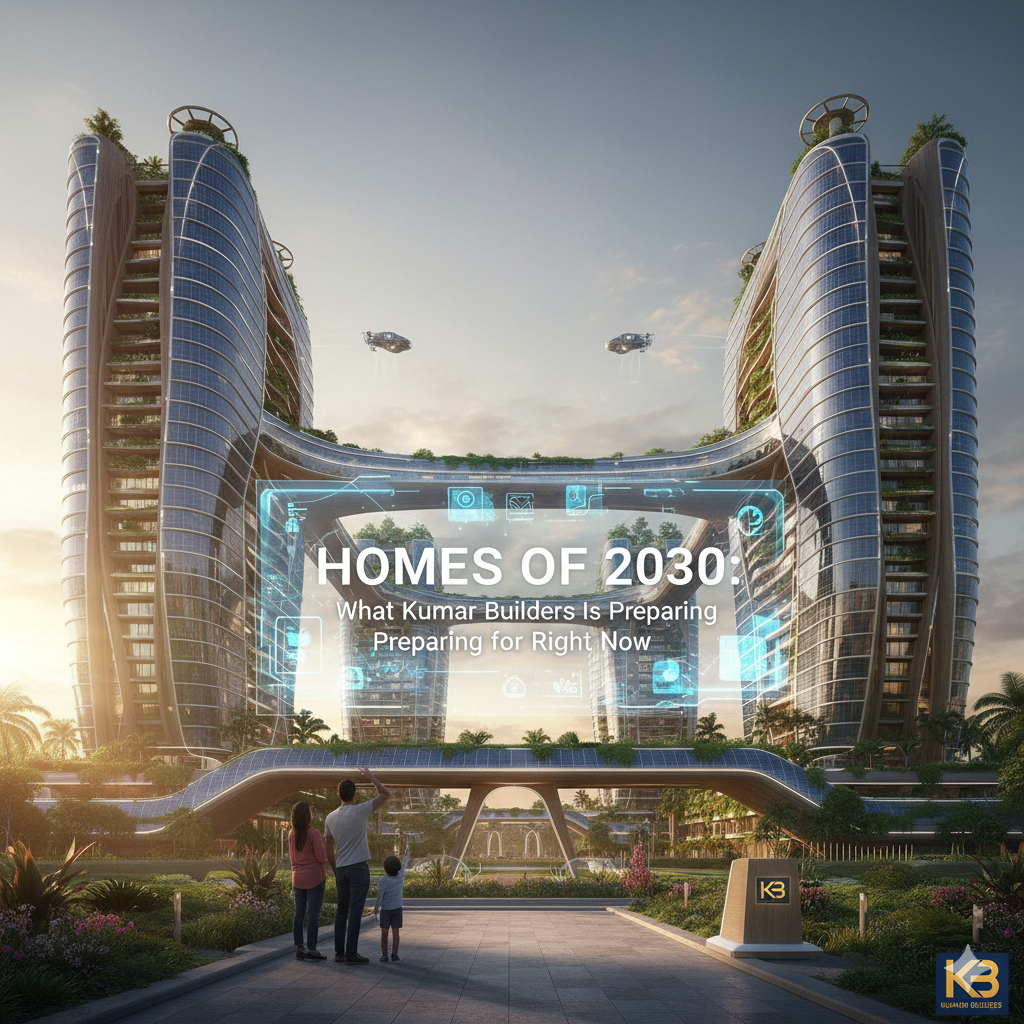
You walk through a solar-sheltered walkway towards a lobby that recognizes your car the moment you enter the premises. The building adjusts lighting and ventilation in real time based on weather and occupancy.
Your home door unlocks with facial recognition.
Inside, the living room adjusts brightness automatically.
The workspace converts from a compact studio to a full office with foldable architectural panels.
A sensor monitors the air and tells you when to ventilate for optimum health.
Your windows are coated with next-gen glazing, keeping your home cool even in peak summer.
A rooftop community garden hosts weekend yoga.
The entire township runs on a cycle of recycled water and solar energy.
Your children can walk safely to school, your parents can reach healthcare facilities within minutes, and you can cycle to nearby commercial hubs.
This isn’t imagination.
This is preparation.
This is the path laid out clearly in Kumar Builders News.
Conclusion: The Future Is Not 2030—It’s Now
Homes of 2030 won’t be defined by what gadgets they have or how tall the towers are. They will be defined by how deeply they understand the needs of people—families, children, professionals, seniors, pets, and communities.
Kumar Builders is already building with that future in mind.
Their projects reflect foresight, emotional intelligence, sustainability, and smart design—qualities that will matter even more in the next decade.
If you’re following Kumar Builders News, you’re essentially getting a preview of the future of Indian real estate.
Because by the time 2030 arrives, many developers will try to catch up.
But Kumar Builders will already be there—leading the change.